

Introduction
More than 2 lakh knee replacement surgeries are performed annually in India. With modern techniques like robotic-assisted surgery and enhanced recovery protocols, knee replacement has become one of the most successful procedures in orthopedic medicine. At Medicare Hospital, we specialize in advanced knee replacement with comprehensive pre- and post-operative care.
Is Knee Replacement Right for You?
Knee replacement is typically recommended when:
- Conservative treatments no longer provide relief
- Knee pain interferes with daily activities (walking, climbing stairs, getting up from a chair)
- You have significant night pain affecting sleep
- X-rays show advanced bone-on-bone arthritis
- Your quality of life is severely impacted
Explore our Joint Replacement – Hip & Knee services to understand all available options.
Types of Knee Replacement Surgery
| Type | Description | Best For |
| Total Knee Replacement (TKR) | All three compartments of the knee are resurfaced | Advanced arthritis throughout the knee |
| Partial Knee Replacement | Only the damaged compartment is replaced | Arthritis limited to one area |
| Patellofemoral Replacement | Only the kneecap and trochlear groove are replaced | Isolated arthritis behind the kneecap |
| Bicompartmental Replacement | Two compartments replaced, preserving the third | Arthritis in two areas |
PART 1: Before Surgery – Preparation Phase
Pre-Operative Evaluation (2-4 weeks before surgery)
- Complete blood count, kidney and liver function tests
- ECG and chest X-ray
- Urinalysis to rule out infection
- Optimization of chronic conditions (diabetes, blood pressure)
- Dental clearance: complete dental work at least 2 weeks before surgery
- Medication adjustments: stop blood thinners 5-7 days before, stop NSAIDs 3 days before
Prehabilitation (Pre-hab)
Studies show patients who participate in pre-operative physical therapy have significantly better outcomes. Our Diagnostics & Physiotherapy team designs customized pre-hab programs. Start 4-6 weeks before surgery:
- Quadriceps sets (tighten thigh muscle, hold 5 seconds)
- Straight leg raises
- Ankle pumps (critical for circulation)
- Heel slides (gentle knee bending)
Home Preparation
- Install grab bars near toilet and shower
- Place a shower chair or bench
- Remove throw rugs and electrical cords (fall hazards)
- Arrange help with cooking, cleaning, and pet care for 2-3 weeks
- Prepare a recovery station with medications, water, snacks, phone, chargers
PART 2: During Surgery – The Procedure
Anesthesia Options
| Type | How It Works | Best For |
| Spinal anesthesia | Numbs from waist down, you are awake | Less nausea, faster recovery – most common |
| General anesthesia | Fully asleep | Anxious patients |
| Spinal + sedation | Spinal plus light sleep (most common) | Best of both – comfortable, breathing independently |
The Surgical Procedure (60-90 minutes)
- Incision – 6-8 inch incision over the front of the knee
- Exposure – Surgeon moves muscles and tendons aside (without cutting them)
- Bone cuts – Damaged cartilage and small amounts of bone removed using precision guides
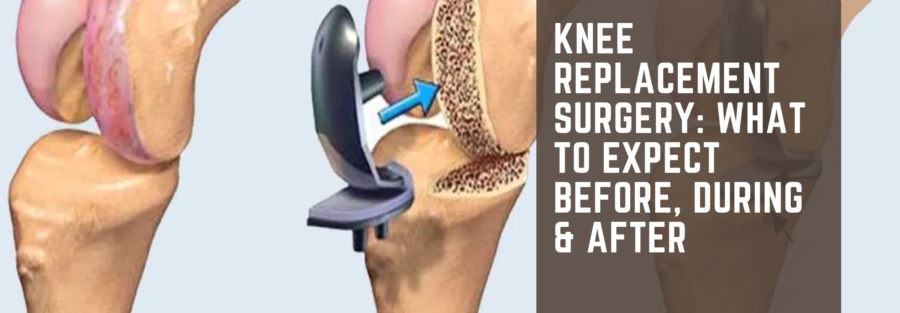
- Implant placement – Metal components cemented or press-fit onto bone ends
- Spacer insertion – Medical-grade polyethylene spacer placed between metal components
- Closure – Layers closed with sutures or staples
| Modern Advances at Medicare Hospital |
| Robotic-assisted TKR uses 3D mapping for millimeter-perfect bone cuts. Cementless implants allow bone growth into the implant for younger, more active patients. |
PART 3: After Surgery – Recovery & Rehabilitation
Hospital Stay (2-4 days)
Day 0: Recovery room, pain management (spinal or PCA), CPM machine if prescribed, ice and elevation.
Day 1: Physiotherapist visits within 24 hours, stand with walker, take 3-5 steps, drain removal.
Day 2: Walk to bathroom, climb 2-3 stairs, achieve 70-90 degree bend. Stair training begins.
Discharge (Day 3-4): Walk 100-200 feet with walker, climb 3-4 stairs, bend knee to 90 degrees, fully straighten.
Recovery Timeline
| Timeframe | Milestone |
| Week 1-2 | Walker use, ice/elevation 4-6x daily, home exercises 2-3x daily |
| Week 2-4 | Walker to cane transition, knee bend 100-110 degrees |
| Week 4-6 | Most patients walk without device at home, driving possible (left knee) |
| Month 3 | Walk 1-2 km without pain |
| Month 4-5 | Stairs foot-over-foot, return to golf and doubles tennis |
| Month 6-12 | Full recovery, 90-95% final strength and function |
Our Diagnostics & Physiotherapy department provides specialized post-operative rehabilitation programs to ensure the best possible outcome.
Long-Term Activity Guidelines
| Activity | Recommended? |
| Walking, swimming, cycling | YES – excellent low-impact choices |
| Golf, doubles tennis, bowling | YES – well tolerated |
| Hiking (moderate terrain) | YES – after full recovery |
| Running, jogging | NO – not recommended |
| High-impact sports (basketball, soccer) | NO – avoid |
| Heavy lifting (>25 kg regularly) | NO – avoid |
Potential Complications (And How They Are Managed)
| Complication | Incidence | Prevention/Treatment |
| Blood clots (DVT) | 1-2% | Blood thinners, ankle pumps, early walking |
| Infection | <1% | Antibiotics before/during surgery, sterile technique |
| Stiffness (arthrofibrosis) | 3-5% | Dedicated physiotherapy, manipulation if needed |
| Implant loosening | <2% at 10 years | Proper surgical technique, avoiding high-impact activities |
| Persistent pain | 5-10% | Pain management, sometimes revision surgery |
Success Rates and Implant Longevity
- 90-95% implant survival at 10 years
- 80-85% at 20 years
- 70-75% at 25 years
Factors affecting longevity: patient weight (lower BMI = longer implant life), activity level (low-impact activities), surgical technique (robotic assistance improves alignment), and implant type.
Conclusion
Knee replacement surgery is a life-changing procedure. At Medicare Hospital, we specialize in advanced knee replacement including robotic-assisted surgery and comprehensive rehabilitation support. Explore our complete orthopedic services for more information.
Frequently Asked Questions
Q: How painful is knee replacement surgery?
A: Pain is well-controlled with modern multimodal analgesia (nerve blocks, spinal anesthesia, oral medications). Most patients describe the pain as ‘less than I expected.’
Q: When can I drive after knee replacement?
A: Left knee: 2-4 weeks. Right knee: 4-6 weeks (or when you can stomp the brake in an emergency). Always confirm with your surgeon.
Q: Will I set off metal detectors?
A: Yes, most modern implants will trigger airport metal detectors. Carry your implant ID card (provided after surgery).
Q: How long before I can travel by plane?
A: Minimum 6-8 weeks to reduce DVT risk. Wear compression stockings, walk every hour, and stay hydrated.